We Use CookiesWe use cookies to enhance the security, performance, functionality and for analytical and promotional activities. By continuing to browse this site you are agreeing to our privacy policy

10 Best Casio Keyboards 2025 in the United States

How do we rank products for you?

Our technology thoroughly searches through the online shopping world, reviewing hundreds of sites. We then process and analyze this information, updating in real-time to bring you the latest top-rated products. This way, you always get the best and most current options available.

headphones-stars

Our Top Picks

#1

Winner

Casio Privia PX-S7000 Portable Digital Piano w/88 Hybrid Weighted Keys, 400 Tones, Touch Sensor Controls, Stand w/ 3 Pedals, Bluetooth, USB, AC Adapter, 32W Speakers, Harmonious Mustard (PX-S7000HM)

The Casio Privia PX-S7000 stands out as an impressive digital piano with its 88 Smart Hybrid Hammer Action Keybed that mimics the feel of an acoustic piano, making it suitable for players of all skill levels. With 256-note polyphony, it handles complex compositions effortlessly, and the 400 built-in sounds offer a vast range of tones to explore. Touch sensitivity is another strong point, enhancing expressiveness during play.

The included stand with 3 pedals adds to the authentic piano playing experience, while the string damper resonance simulation further enriches the sound quality. For connectivity, it supports Bluetooth and USB, making it easy to connect to external devices and software, which is great for recording and practice sessions. However, at 64.2 pounds, its portability is somewhat limited, which could be a consideration for those who need to move it frequently.

The unique Harmonious Mustard color might not appeal to everyone’s taste, though it certainly adds a modern aesthetic. The built-in 32W speakers provide robust sound output, suitable for home use and smaller venues. While the price is on the higher end, the features justify the investment for serious learners and enthusiasts. The PX-S7000 is a feature-rich digital piano that excels in sound quality, key feel, and connectivity options, though its weight and distinctive color may not suit everyone’s needs.

#2

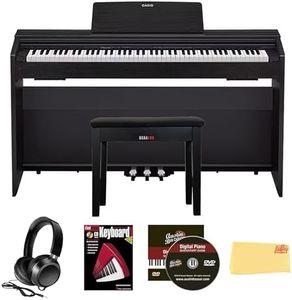
Casio CDP-S1A 88-Key Digital Piano Bundle - Limited Edition

Rating
8.2
Portability

Most important from
10 reviews

Portability
The piano is lightweight and easy to assemble, making it ideal for beginners and young learners.

The Casio CDP-S1A is a compact digital piano designed with 88 fully weighted keys, mimicking the feel of an acoustic piano, making it suitable for both beginners and experienced players. Its touch sensitivity allows for expressive playing by responding to how hard or soft the keys are pressed. Casio digital pianos typically support sufficient polyphony for most practice and performance needs.

The piano comes bundled with a matching wooden stand, an adjustable padded bench, a sustain pedal, and a music rest, providing a complete setup right out of the box. It is lightweight and reasonably portable at just over 23 pounds, with the ability to run on six AA batteries, which is handy for playing in places without power outlets. Connectivity options include a standard 3.5mm headphone jack and an auxiliary input, allowing for easy connection of headphones or external devices, though it does not have USB or Bluetooth connectivity.

Focusing on simplicity and quality sound, the CDP-S1A includes built-in tones and rhythms but does not emphasize extensive learning features or a wide variety of sounds compared to some other models. This piano is a solid choice for those seeking an authentic piano feel in a compact, well-equipped package, especially suited for home practice and beginner to intermediate players.

Rating
8.2
Portability

Most important from
10 reviews

Portability
The piano is lightweight and easy to assemble, making it ideal for beginners and young learners.
#3

Casio CT-X5000 – 61-Key Flagship Arranger Keyboard | 800 Tones, 235 Rhythms, Editable DSP Effects, 17-Track Recorder, 30W Speakers, Mic & Line Outs, USB MIDI, Phrase Pads | Pro Performance

Rating
7.6
Touch Sensitivity
Built-in Tones and Rhythms

Most important from
125 reviews

Touch Sensitivity
The soft-touch buttons and weighted keys provide a satisfying playing experience.
Built-in Tones and Rhythms
The semi-weighted keys and endless customizations rival features of professional studio keyboards costing thousands.

The Casio CT-X5000 61-Key Portable Keyboard is a versatile choice, especially for beginners. One of its main strengths is the 61 full-size, touch-responsive keys which provide a realistic playing experience.

The keyboard boasts an impressive selection of 800 tones and 235 rhythms, all of which can be edited to suit your preferences, making it suitable for various musical styles. The built-in pitch bend wheel and assignable mod button add a layer of expressiveness to your playing, which is a nice touch. The USB-MIDI and USB device ports allow for easy connectivity with computers and other devices, enhancing its versatility for different setups.

Additionally, the keyboard is portable and comes with an AC adapter and a tablet-ready music rest, making it convenient for on-the-go practice or performances. It may not offer the advanced features more experienced players might seek. The Casio CT-X5000 is a solid choice for beginners and those who value portability and a wide range of tones and rhythms.

Rating
7.6
Touch Sensitivity
Built-in Tones and Rhythms

Most important from
125 reviews

Touch Sensitivity
The soft-touch buttons and weighted keys provide a satisfying playing experience.
Built-in Tones and Rhythms
The semi-weighted keys and endless customizations rival features of professional studio keyboards costing thousands.

Buying Guide for the Best Casio Keyboards

Choosing the right Casio keyboard can be a rewarding experience if you know what to look for. Whether you're a beginner, an intermediate player, or a professional, there are certain key specifications that will help you find the best fit for your needs. Understanding these specs will ensure that you get the most out of your keyboard and enjoy playing it for years to come.
Number of KeysThe number of keys on a keyboard is crucial as it determines the range of notes you can play. Keyboards typically come with 61, 76, or 88 keys. A 61-key keyboard is suitable for beginners and those with limited space. A 76-key keyboard offers a wider range and is good for intermediate players. An 88-key keyboard is full-sized, like a traditional piano, and is ideal for advanced players or those who want the full range of notes. Consider your skill level and the type of music you want to play when choosing the number of keys.
Touch SensitivityTouch sensitivity refers to how the keyboard responds to the force with which you press the keys. This feature is important because it allows for more expressive playing. Keyboards can have no touch sensitivity, single touch sensitivity, or graded touch sensitivity. No touch sensitivity means the volume is the same no matter how hard you press. Single touch sensitivity means the volume changes with the force of your press. Graded touch sensitivity mimics an acoustic piano, with heavier touch in the lower keys and lighter touch in the higher keys. Beginners might start with no or single touch sensitivity, while more advanced players will benefit from graded touch sensitivity.
PolyphonyPolyphony is the number of notes a keyboard can produce at the same time. This is important for playing complex pieces of music where multiple notes and chords are played simultaneously. Keyboards typically offer 32, 48, 64, 128, or even 256-note polyphony. For beginners, 32 or 48-note polyphony is usually sufficient. Intermediate players might prefer 64-note polyphony, while advanced players and those who use a lot of layering and sustain will benefit from 128-note polyphony or higher.
Built-in Tones and RhythmsBuilt-in tones and rhythms add variety to your playing experience by providing different sounds and accompaniment styles. Keyboards can have a few dozen to several hundred built-in tones and rhythms. Beginners might not need a vast array of options, so a keyboard with fewer tones and rhythms will suffice. Intermediate and advanced players, or those who enjoy experimenting with different sounds, will benefit from a keyboard with a larger selection of built-in tones and rhythms.
Learning FeaturesLearning features are designed to help beginners and intermediate players improve their skills. These can include built-in lessons, light-up keys, and connectivity to learning apps. Keyboards with these features can guide you through songs, show you which keys to press, and provide feedback on your playing. If you're a beginner or someone looking to improve your skills, choosing a keyboard with robust learning features can be very beneficial.
PortabilityPortability is an important factor if you plan to move your keyboard frequently or have limited space. Lightweight and compact keyboards are easier to transport and store. If you need a keyboard for home use and don't plan to move it often, portability might be less of a concern. However, if you need to take your keyboard to lessons, gigs, or practice sessions, a more portable model will be advantageous.
Connectivity OptionsConnectivity options allow you to connect your keyboard to other devices, such as computers, tablets, and external speakers. Common connectivity options include USB, MIDI, and audio outputs. USB and MIDI connections are useful for recording and using music software, while audio outputs are important for connecting to external speakers or amplifiers. Consider how you plan to use your keyboard and what devices you want to connect it to when evaluating connectivity options.

FAQ